
Robonaut
 Subsystems
Hand
Arms
Head
Controls
Avionics
Telepresence
Videos
Hand (5.3 M)
Telepresence (3.3 M)
Arm motion (2.9 M)
Grasping (2.1 M)
Tether hook (1.9 M)
Velcro (2.7 M)
Tools Analysis tools
Software development
Telepresence Laboratory
Survey Humanoid robots around the world

|
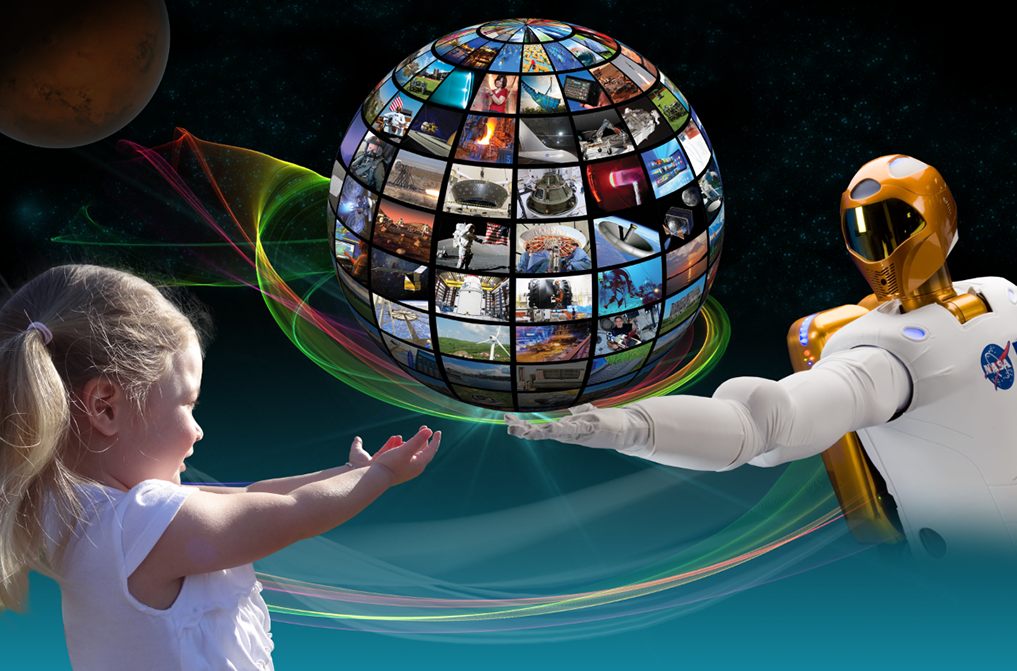
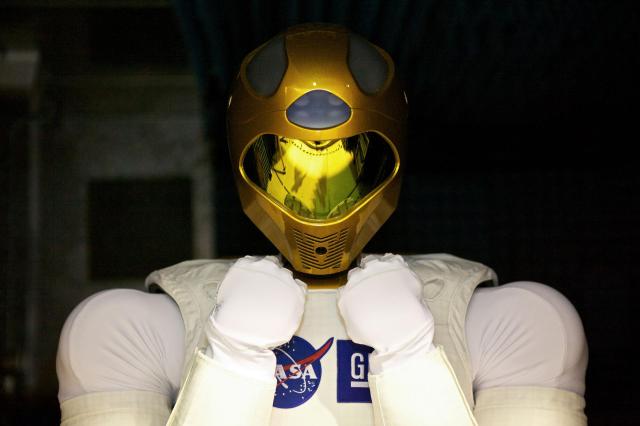
NASA is building an advanced humanoid system called
Robonaut,currently under development at the Johnson Space Center. |
The Shape of Things to Come
We're using a humanoid shape to meet NASA's increasing requirements for
Extravehicular Activity (EVA, or spacewalks). Over the past five
decades, space flight hardware has been designed for human
servicing.Space walks are planned for most of the assembly missions for the
International Space Station, and they are a key contingency for
resolving on-orbit failures. Combined with our substantial
investmentin EVA tools, this accumulation of equipment requiring a
humanoid shapeand an assumed level of human performance presents a
unique opportunityfor a humanoid system.
While the depth and breadth of human performance is beyond the current
state of the art in robotics, NASA targeted the reduced dexterity and
performance of a suited astronaut as Robonaut's design goals,
specifically using the work envelope, ranges of motion, strength and
endurance capabilities of space walking humans. This Web site
describes the design effort for the entire Robonaut system, including
mechanisms, avionics, computational architecture and telepresence
control. Mechanism Design
The manipulator and dexterous hand have been developed with
asubstantial investment in mechatronics design. The arm
structure has embedded avionics elements within each link,
reducing cabling and noise contamination. Unlike some systems,
Robonaut uses a chordate approach to data management, bringing all
feedback to a central nervous system,where even low-level servo
control is performed. This biologically inspired neurological
approach is extended to left-right computational symmetry, sensor
and power duality and kinematical redundancy, enabling
learning and optimization in mechanical, electrical and software
forms.
The theory that manufacturing tools
caused humans to evolve by requiring skills that could be
naturally selected is applied to Robonaut's design as well.
The set of EVA tools used by astronauts was the initial design
consideration for the system, hence the development of Robonaut's
dexterous five-fingered hand and human-scale arm that exceeds
the range of motion of even unsuited astronauts. Packaging
requirements for the entire system were derived from the
geometry of EVA access corridors, such as pathways on the
Space Station and airlocks built for humans. |
Sensors and Telepresence Control
Robonaut's broad mix of sensors includes thermal, position, tactile,force
and torque instrumentation, with over 150 sensors per arm. The
control system for Robonaut includes an onboard, real time CPU with
miniature data acquisition and power management in a small,environmentally
hardened body. Off-board guidance is delivered with
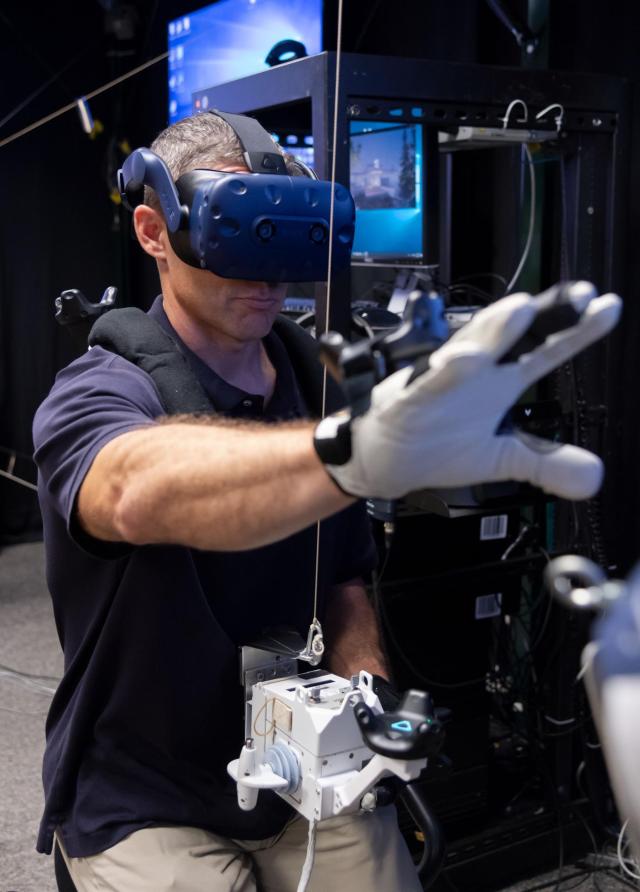
human supervision using a telepresence control station with human tracking.
Meeting the needsTo meet the dexterous manipulation
needs foreseen in future NASAmissions, the Automation, Robotics,
and Simulation Division at JohnsonSpace Center is developing
Robonaut, a highly dexterous anthropomorphicrobotic system.
Robonaut is advancing the state of the art in anthropomorphic
robotic systems, multiple use tool handling end effectors, modular
robotic systems components and telepresence controlsystems.
The project has adopted the design concept of an
anthropomorphic robot the size of an astronaut in a space
suit and configured with two arms, two five-fingered hands,
a head and a torso. Its dexterous pair of arms enables
dual-arm operations and its handscan interface directly with
a wide range of interfaces without specialtooling. Its
anthropomorphic design enables intuitive telepresence control
by a human operator. |
|