



ER3
Flight Systems
Branch
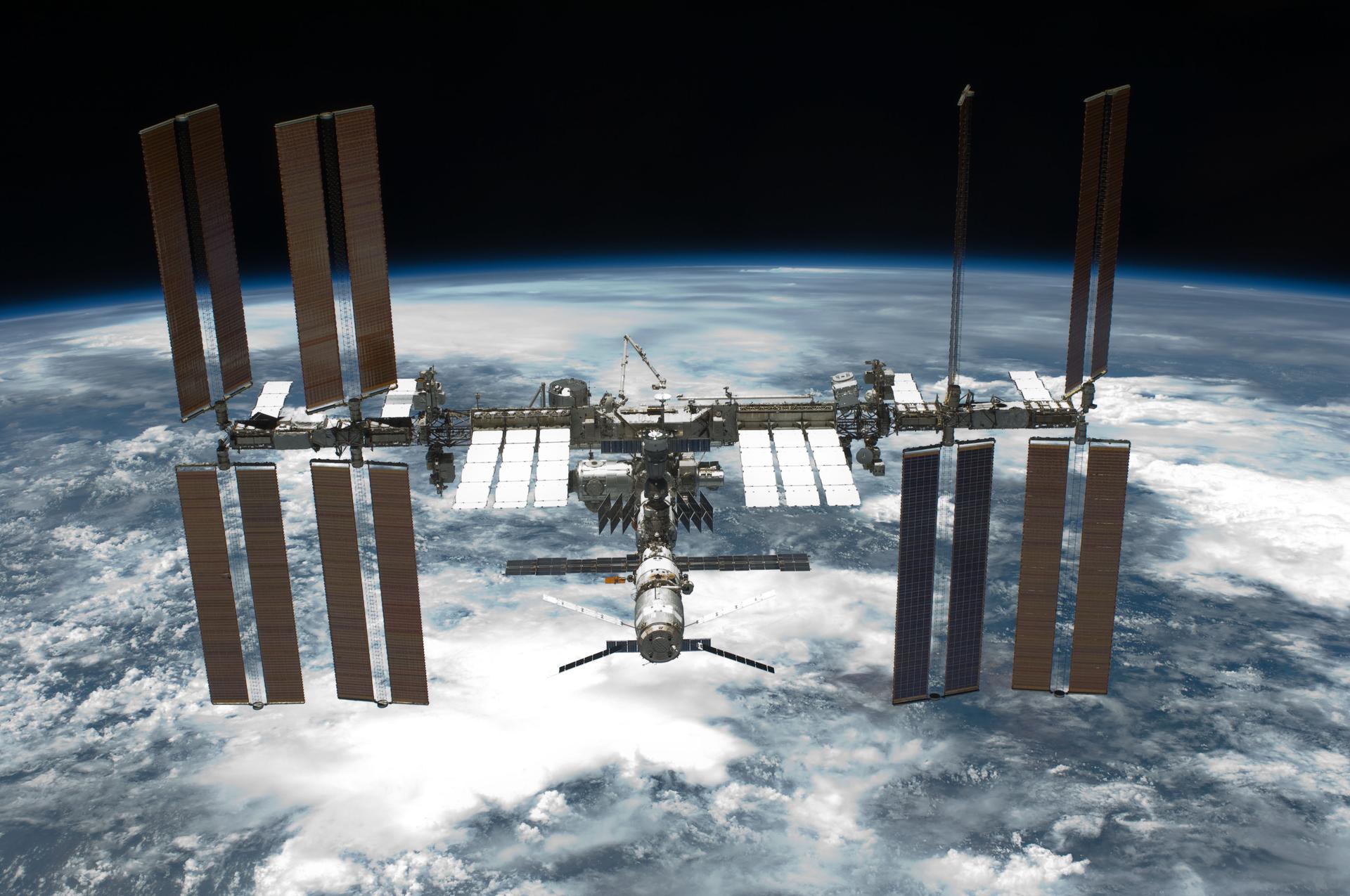
The Flight Systems Branch provides the robotic systems management and engineering support to the International Space Station (ISS) for the ISS Mobile Servicing System (MSS). In addition, in-line support is provided for robotic related tasks such as SSRMS capture and berthing analysis, robotic user interface displays for the Robotic Workstation, MSS software integration, and robotic berthing camera systems. The Flight Systems Branch also provides System Management for the ISS Countermeasure Systems hardware and GFE project management for the Treadmill with Vibration Isolation and Stabilization (TVIS), Advanced Resistive Exercise Device (ARED), Cycle Ergometer with Vibration Isolation and Stabilization (CEVIS) and other GFE hardware.
Robotic Systems Management/Engineering Support for ISS
ISS Visiting Vehicle Capture Analysis

ER3 is supporting these future visiting vehicle robotic capture operations by performing engineering analysis to ensure Mission Safety and Mission Success. Analysis performed includes real-time crew capture studies used to show NASA Astronauts can successfully capture a visiting vehicle using the Canadian robotic arm. Failed capture clearance analyses are performed to ensure in the event of an unsuccessful capture no damage is done to the ISS. Lastly, capture loads analysis is performed to ensure no hardware (ISS, Robotic arm, or Vehicle) is damaged during the capturing process.
SSRMS Berthing Analysis

ER3 has supported this team from the beginning by providing integration of analysis products and performing end-to-end dynamic robotic analysis. This took the form of the development of simulation scenarios to support analysis of end-to-end berthing tasks, and engineering analyses (both pilot-in-the-loop and non-real-time) of integrated manipulator/mechanism performances.
With the ISS assembly phase completed during STS-134 in May 2011, EBIT has shifted to analyzing the berthing of visiting vehicles such as HTV and future visiting vehicles like Dragon and Cygnus. In addition, EBIT will be analyzing the extraction of the many planned NASA payloads that will be delivered to the ISS from the truck of these visiting vehicles. EBIT will be involved with the relocation of ISS modules/components from one berthing location to another berthing location. In all of these tasks, ER3 will continue to play an integral role in the supporting EBIT by ensuring that no loads exceedences are experienced by the following structures: SSRMS, grapple fixture, berthing mechanisms on both the vehicle/payload and the ISS sides.
Simulated Robotics Workstation

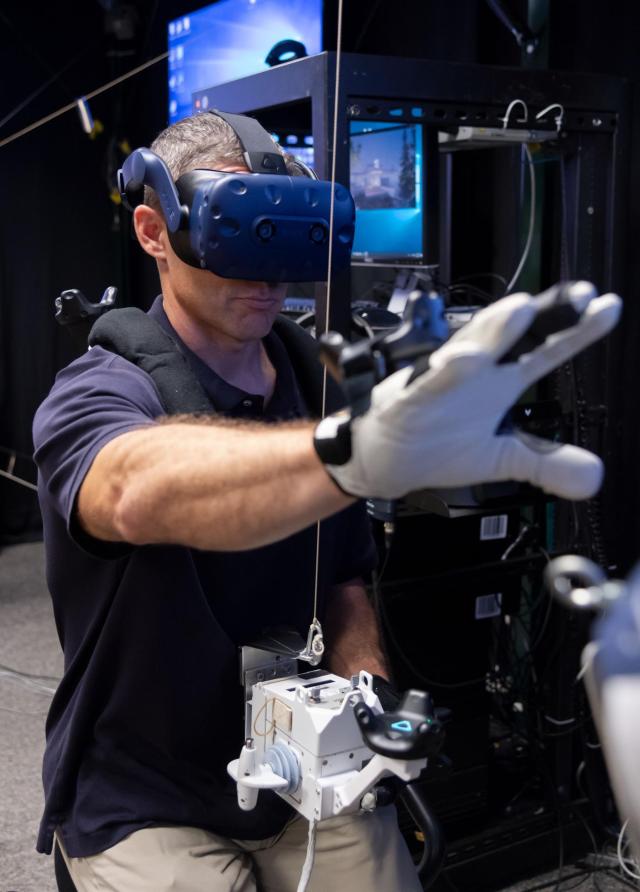
Designed as a functional equivalent to the flight system, the SRWS has the same form factor monitors, hand controllers, video control panel, visiting vehicle control panel, and portable computer system (PCS) as the real thing. But, unlike flight software and hardware, it is designed for rapid prototyping, wide-spread distribution for training purposes, and broad capabilities for verification, crew trials, risk mitigation testing, mission support, and post-flight analysis. Visual 3D scenes of the visiting vehicle and ISS displayed from the crew operator's point of view are overlaid with dynamic graphics elements showing vital information such as approach corridor and abort boundaries, as well as quantitative data such as distance from ISS, velocity, and position. Allowing full interactive control of cameras, robotic arms, end effectors, and visiting vehicle commands, the SRWS provides a good simulation of what the crew will see on orbit.
Centerline Berthing Camera System (CBCS)

The Centerline Berthing Camera System is the primary cue system for ISS assembly, relocation and resupply tasks involving berthing of pressurized and non-pressurized elements . This system provides relative-state, alignment information to the ISS Remote Manipulator System operator for robotic berthing tasks.
First deployed in 2000 to support berthing of the US Lab to Node 1, the system is comprised of a precision aligned camera, an LED light ring used for illumination of target reflective elements, avionics boxes and cables required for integration with ISS power and video systems, and a precision aligned, reflective element target mounted on the incoming module.
The CBCS camera is attached to the internal window frame of the Common Berthing Mechanism (CBM) hatch on the ISS pressurized element, providing a view of the target on the incoming element. For non-pressurized elements such as the PMA, the CBCS target has a polished alumninum, mirrored surface; For pressurized elements such as the US Lab or MPLMs, the CBM hatch window on the incoming element acts as the mirror and a simple, decal style target is attached to the perimeter of the external window frame, providing the additional reflective element cues.
The CBCS video image is routed to the ISS Robotic Work Station (RWS) or the Orbiter aft flight deck monitors for use by the SRMS or SSRMS operators. Electronic overlays on the RWS provide the system operator with reference indicators which, used in conjunction with the CBCS video image, allows them to maintain the proper berthing corridor while connecting the 2 modules.
The CBCS has been successfully used in the installation of the US Lab, Nodes, PMAs, MPLMs, ESA elements such as Cupola and Columbus, as well as JAXA elements such as the JEM-PM, JEM-PS, CAM and HTV-1.
The CBCS team will continue to integrate the CBCS system with NASA, commercial, and International Partner flight elements for the use as the primary berthing cue system for ISS resupply missions.
ISS Countermeasures

Cycle Ergometer with Vibration Isolation and Stabilization (CEVIS)
The Cycle Ergometer with Vibration Isolation and Stabilization (CEVIS) provides the ability for recumbent or upright cycling in order to provide aerobic exercise and is intended as a countermeasure for the deleterious physiological effects of exposure to weightlessness that are anticipated during stays on the International Space Station (ISS). CEVIS also has the capability to support pre-breathe extravehicular activities (EVA), periodic fitness evaluations (PFE), and pre-landing fitness evaluations. CEVIS contains an inertial vibration isolation system that is used to counteract the motions generated by a crewmember exercising on the cycle ergometer to reduce vibrations to the ISS structure.
Blood Pressure / Electrocardiograph (BP/ECG)
The Blood Pressure / Electrocardiograph (BP/ECG) monitor measures and records blood pressure, heart rate, and cardiac waveforms during the Performance Fitness Evaluations (PFE). The PFE is an exercise protocol performed by each of the crew members aboard ISS once per month in order to gauge the crew members’ cardiopulmonary health. The BP/ECG device can also assist in a cardiac arrest emergency to monitor cardiac waveforms in combination with a defibrillator. The BP/ECG device incorporates unique system enabling the reduction of the usual number of signal leads connected to the body from 12 to 5, while still maintaining the capability for high signal fidelity. The reduced number of leads allows for the BP/ECG monitor to be less obtrusive during exercise and also supports quicker setup of the system which may be a great benefit in an emergency situation.

Treadmill with Vibration Isolation & Stabilization (TVIS)
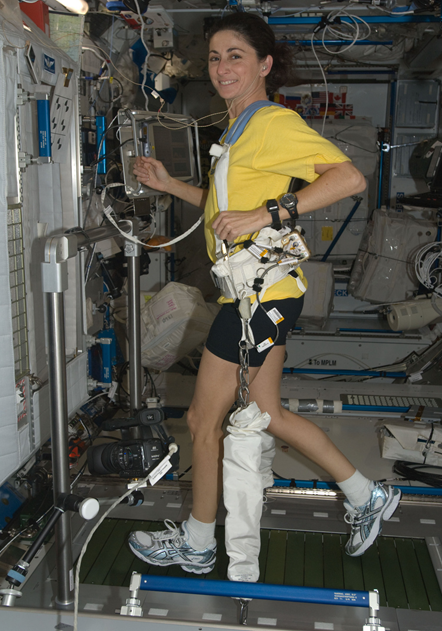
TVIS is an exercise system that is classified as Government furnished equipment (GFE) and was designed for use as a component of the Crew Health Care System (CHeCS) in the Russian Service Module (SM). The treadmill is designed to allow walking and running, knee bends, and resistive exercise in a zero gravity environment for maintenance of cardiovascular fitness, muscular strength, and the exercise of neurophysiological pathways and reflexes required to walk, upon return to the Earth.
The Vibration Isolation & Stabilization (VIS) system is intended to minimize the transfer of dynamic forces caused by operation of the treadmill to the structure of the Service Module (SM) and other parts of the International Space Station (ISS), while at the same time maintaining a stable running/walking surface. The active components of the VIS system are a Gyroscope and four slide-mass Stabilizers. The VIS components are software-controlled and work in unison to counteract the pitch and roll forces imparted to the TVIS platform by the runner. The VIS system also serves to provide current peak smoothing of the TVIS power sources.
The running surface of the treadmill is used in much the same way as any treadmill except the user is held on the surface by latex rubber tubes (Series Bungee Systems, SBS) and/or Subject Load Devices (SLDs) attached to the runner’s exercise harness. When used without the SLDs, the SBSs are considered the contingency loading configuration.

Advanced Resistive Exercise Device (ARED)
ARED provides the capability to perform resistive exercise on-orbit that simulates exercise with free weights in a 1-g environment. Crewmembers will use ARED to perform squats, deadlifts, calf raises, and a number of exercises adequate to load all the major muscle groups. Maintenance of crew health in this way is necessary for the crewmember’s capability to perform Extravehicular Activities (EVAs), to perform emergency response and emergency egress activities, to minimize recovery and acclimatization time to 1-g on the ground following a mission, and to maintain psychological health while on-orbit.
Exercises on ARED are performed while preserving the microgravity environment provided by the International Space Station (ISS). The ARED isolates the vibrations and forces generated by an exercising crewmember from the ISS vehicle structure preserving fatigue life of the structure and limiting operational constraints on exercise during payload experiments requiring microgravity . ARED also provides the capability for crewmembers to view the exercise prescriptions generated by the Astronaut Strength Conditioning and Rehabilitation (ASCR) trainer and their progress during an exercise session.
Flight Project Development
Under Development